

15 Degree F To C
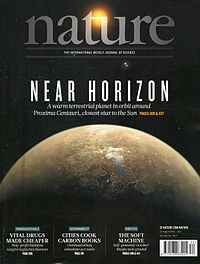 Cover of a 2016 issue of Nature featuring artistic representation of Proxima Centauri and its planet Proxima b | |
| Discipline | Natural sciences |
|---|---|
| Language | English |
| Edited by | Magdalena Skipper |
| Publication details | |
| History | iv November 1869 – present |
| Publisher | Nature Research (subsidiary of Springer Nature) (United Kingdom) |
| Frequency | Weekly |
| Impact factor | 69.504 (2021) |
| Standard abbreviations ISO 4 (alt)· Bluebook (alt1· alt2) NLM (alt)· MathSciNet (alt  ) ) | |
| ISO four | Nature |
| Indexing CODEN· JSTOR (alt)· LCCN (alt) MIAR· NLM (alt)· Scopus | |
| CODEN | NATUAS |
| ISSN | 0028-0836 (print) 1476-4687 (spider web) |
| LCCN | 12037118 |
| OCLC no. | 01586310 |
| Links | |
| |
Nature is a British weekly scientific journal founded and based in London, England. As a multidisciplinary publication, Nature features peer-reviewed inquiry from a variety of academic disciplines, mainly in science and technology. It has core editorial offices across the United states of america, continental Europe, and Asia nether the international scientific publishing visitor Springer Nature. Nature was 1 of the world's nearly cited scientific journals past the Science Edition of the 2019 Journal Citation Reports (with an ascribed impact factor of 42.778),[1] making it one of the world's about-read and near prestigious academic journals.[2] [3] [iv] As of 2012[update], information technology claimed an online readership of almost iii million unique readers per month.[v]
Founded in autumn 1869, Nature was first circulated by Norman Lockyer and Alexander Macmillan equally a public forum for scientific innovations. The mid-20th century facilitated an editorial expansion for the journal; Nature redoubled its efforts in explanatory and scientific journalism. The late 1980s and early 1990s saw the cosmos of a network of editorial offices outside of Uk and the establishment of ten new supplementary, speciality publications (e.g. Nature Materials). Since the late 2000s, dedicated editorial and current affairs columns are created weekly, and electoral endorsements are featured. The chief source of the periodical remains, as established at its founding, research scientists; editing standards are primarily concerned with technical readability. Each consequence as well features manufactures that are of general interest to the scientific community, namely business, funding, scientific ethics, and research breakthroughs. At that place are likewise sections on books, arts, and short science fiction stories.
The main inquiry published in Nature consists more often than not of papers (articles or letters) in lightly edited class. They are highly technical and dense, merely, due to imposed text limits, they are typically summaries of larger work. Innovations or breakthroughs in whatever scientific or technological field are featured in the journal every bit either messages or news articles. The papers that have been published in this journal are internationally acclaimed for maintaining loftier inquiry standards. Conversely, due to the journal'due south exposure, it has at various times been a bailiwick of controversy for its handling of academic dishonesty, the scientific method, and news coverage. Fewer than 8% of submitted papers are accustomed for publication.[6] In 2007, Nature (together with Science) received the Prince of Asturias Accolade for Communications and Humanity.[7] [viii]
Nature mostly publishes enquiry articles. Spotlight articles are not research papers but by and large news or magazine style papers and hence practise non count towards touch on gene nor receive similar recognition as inquiry articles. Some spotlight manufactures are also paid past partners or sponsors.[9]
History [edit]
Background [edit]
The enormous progress in scientific discipline and mathematics during the 19th century was recorded in journals written more often than not in German or French, as well as in English language. Britain underwent enormous technological and industrial changes and advances particularly in the latter half of the 19th century.[10] The nigh respected scientific journals of this time were the refereed journals of the Regal Order, which had published many of the great works from Isaac Newton and Michael Faraday to Charles Darwin. In addition, the number of popular science periodicals doubled from the 1850s to the 1860s.[11] According to the editors of these popular science magazines, the publications were designed to serve equally "organs of scientific discipline", in essence, a ways of connecting the public to the scientific world.[eleven]
Nature, starting time created in 1869, was not the first magazine of its kind in Britain. One periodical to precede Nature was Recreative Scientific discipline: A Record and Remembrancer of Intellectual Observation,[12] which, created in 1859, began every bit a natural history mag and progressed to include more than physical observational science and technical subjects and less natural history.[13] The journal'south name inverse from its original title to Intellectual Observer: A Review of Natural History, Microscopic Research, and Recreative Science [fourteen] and and so to the Student and Intellectual Observer of Science, Literature, and Art.[xv] While Recreative Scientific discipline had attempted to include more concrete sciences such every bit astronomy and archeology, the Intellectual Observer broadened itself further to include literature and art as well.[15] Similar to Recreative Scientific discipline was the scientific periodical Popular Science Review, created in 1862,[16] which covered different fields of science by creating subsections titled "Scientific Summary" or "Quarterly Retrospect", with book reviews and commentary on the latest scientific works and publications.[16] 2 other journals produced in England prior to the development of Nature were the Quarterly Journal of Science and Scientific Opinion, established in 1864 and 1868, respectively.[fifteen] The journal nigh closely related to Nature in its editorship and format was The Reader, created in 1863; the publication mixed science with literature and art in an endeavor to achieve an audience outside of the scientific community, similar to Popular Scientific discipline Review.[fifteen]
These like journals all ultimately failed. The Pop Science Review survived longest, lasting 20 years and ending its publication in 1881; Recreative Science ceased publication as the Student and Intellectual Observer in 1871. The Quarterly Periodical, after undergoing a number of editorial changes, ceased publication in 1885. The Reader terminated in 1867, and finally, Scientific Opinion lasted a mere two years, until June 1870.[xiii]
Creation [edit]

Commencement championship page, 4 November 1869
Not long after the determination of The Reader, a quondam editor, Norman Lockyer, decided to create a new scientific journal titled Nature,[17] taking its name from a line by William Wordsworth: "To the solid ground of nature trusts the Heed that builds for aye".[18] Get-go owned and published past Alexander Macmillan, Nature was similar to its predecessors in its attempt to "provide cultivated readers with an attainable forum for reading about advances in scientific knowledge."[17] Janet Browne has proposed that "far more than any other scientific discipline journal of the period, Nature was conceived, born, and raised to serve polemic purpose."[17] Many of the early editions of Nature consisted of manufactures written by members of a group that called itself the X Club, a group of scientists known for having liberal, progressive, and somewhat controversial scientific beliefs relative to the time catamenia.[17] Initiated past Thomas Henry Huxley, the grouping consisted of such important scientists as Joseph Dalton Hooker, Herbert Spencer, and John Tyndall, along with some other five scientists and mathematicians; these scientists were all avid supporters of Darwin'southward theory of evolution as common descent, a theory which, during the latter half of the 19th century, received a swell deal of criticism among more than conservative groups of scientists.[xix] Mayhap it was in part its scientific liberality that made Nature a longer-lasting success than its predecessors. John Maddox, editor of Nature from 1966 to 1973 and from 1980 to 1995, suggested at a celebratory dinner for the journal's centennial edition that possibly it was the journalistic qualities of Nature that drew readers in; "journalism" Maddox states, "is a fashion of creating a sense of community among people who would otherwise be isolated from each other. This is what Lockyer's journal did from the start."[xx] In addition, Maddox mentions that the fiscal backing of the journal in its first years by the Macmillan family unit besides immune the journal to flourish and develop more freely than scientific journals earlier information technology.[20]
Editors [edit]
Norman Lockyer, the founder of Nature, was a professor at Imperial College. He was succeeded as editor in 1919 past Sir Richard Gregory.[21] Gregory helped to constitute Nature in the international scientific community. His obituary by the Purple Society stated: "Gregory was always very interested in the international contacts of science, and in the columns of Nature he always gave generous space to accounts of the activities of the International Scientific Unions."[22] During the years 1945 to 1973, editorship of Nature changed three times, first in 1945 to A. J. V. Gale and L. J. F. Brimble (who in 1958 became the sole editor), and then to John Maddox in 1965, and finally to David Davies in 1973.[21] In 1980, Maddox returned every bit editor and retained his position until 1995. Philip Campbell became Editor-in-chief of all Nature publications until 2018. Magdalena Skipper has since become Editor-in-chief.[21]
Expansion and development [edit]
In 1970, Nature first opened its Washington function; other branches opened in New York in 1985, Tokyo and Munich in 1987, Paris in 1989, San Francisco in 2001, Boston in 2004, and Hong Kong in 2005. In 1971, under John Maddox's editorship, the journal split into Nature Concrete Sciences (published on Mondays), Nature New Biology (published on Wednesdays), and Nature (published on Fridays). In 1974, Maddox was no longer editor, and the journals were merged into Nature.[23] Starting in the 1980s, the journal underwent a corking deal of expansion, launching over ten new journals. These new journals incorporate Nature Research, which was created in 1999 under the name Nature Publishing Group and includes Nature, Nature Inquiry Journals, Stockton Press Specialist Journals and Macmillan Reference (renamed NPG Reference). In 1996, Nature created its own website[24] and in 1999 Nature Publishing Grouping began its serial of Nature Reviews.[21] Some articles and papers are available for free on the Nature website, while others require the purchase of premium access to the site. As of 2012[update], Nature claimed an online readership of about 3 one thousand thousand unique readers per calendar month.[5]
On 30 October 2008, Nature endorsed an American presidential candidate for the first time when it supported Barack Obama during his entrada in America'due south 2008 presidential ballot.[25] [26] In October 2012, an Arabic edition of the magazine was launched in partnership with King Abdulaziz City for Science and Technology. As of the time information technology was released, information technology had most 10,000 subscribers.[27] On 2 December 2014, Nature appear that it would permit its subscribers and a grouping of selected media outlets to share links allowing gratuitous, "read-only" access to content from its journals. These articles are presented using the digital rights direction organisation ReadCube (which is funded by the Macmillan subsidiary Digital Science), and does not allow readers to download, copy, print, or otherwise distribute the content. While it does, to an extent, provide free online admission to articles, it is not a true open admission scheme due to its restrictions on re-utilise and distribution.[28] [29] On fifteen Jan 2015, details of a proposed merger with Springer Scientific discipline+Business Media were announced.[thirty]
In May 2015 it came under the umbrella of Springer Nature, past the merger of Springer Science+Business organisation Media and Holtzbrinck Publishing Group's Nature Publishing Group, Palgrave Macmillan, and Macmillan Education.[31] Since 2011, the journal has published Nature's ten "people who mattered" during the year, as part of their annual review.[32] [33]
Publication in Nature [edit]

Skewed curve of citations per article in 2015 to Nature articles from 2013 to 2014.
According to Science, another academic journal, being published in Nature has been known to carry a sure level of prestige in academia.[34] In item, empirical papers are frequently highly cited, which can atomic number 82 to promotions, grant funding, and attention from the mainstream media. Considering of these positive feedback effects, competition among scientists to publish in loftier-level journals like Nature and its closest competitor, Science, can be very tearing. Nature 's impact factor, a measure of how many citations a journal generates in other works, was 42.778 in 2019 (as measured by Thomson ISI).[1] [35] [36] However, equally with many journals, virtually papers receive far fewer citations than the bear upon factor would indicate.[37] Nature's journal touch factor carries a long tail.[38]
As with nearly other professional scientific journals, papers undergo an initial screening by the editor, followed by peer review (in which other scientists, chosen by the editor for expertise with the bailiwick matter but who have no connection to the research under review, volition read and critique articles), before publication. In the case of Nature, they are only sent for review if it is decided that they deal with a topical subject and are sufficiently ground-breaking in that item field. As a consequence, the bulk of submitted papers are rejected without review.
According to Nature 'south original mission statement:
It is intended, Beginning, to place before the general public the grand results of Scientific Work and Scientific Discovery; and to urge the claims of Scientific discipline to a more general recognition in Education and in Daily Life; and, SECONDLY, to help Scientific men themselves, by giving early on information of all advances made in whatsoever branch of Natural knowledge throughout the globe, and by affording them an opportunity of discussing the various Scientific questions which arise from time to fourth dimension.[39]
This was afterward revised to:
First, to serve scientists through prompt publication of meaning advances in any branch of science, and to provide a forum for the reporting and discussion of news and issues concerning science. 2d, to ensure that the results of science are chop-chop disseminated to the public throughout the world, in a fashion that conveys their significance for knowledge, civilisation and daily life.[forty]
Landmark papers [edit]
Many of the well-nigh meaning scientific breakthroughs in modern history take been first published in Nature. The following is a selection of scientific breakthroughs published in Nature, all of which had far-reaching consequences, and the citation for the commodity in which they were published.
- Wave nature of particles — C. Davisson and L. H. Germer (1927). "The scattering of electrons by a single crystal of nickel". Nature. 119 (2998): 558–560. Bibcode:1927Natur.119..558D. doi:x.1038/119558a0. S2CID 4104602.
- The neutron — J. Chadwick (1932). "Possible existence of a neutron". Nature. 129 (3252): 312. Bibcode:1932Natur.129Q.312C. doi:ten.1038/129312a0. S2CID 4076465.
- Nuclear fission — L. Meitner and O. R. Frisch (1939). "Disintegration of uranium by neutrons: a new type of nuclear reaction". Nature. 143 (3615): 239–240. Bibcode:1939Natur.143..239M. doi:10.1038/143239a0. S2CID 4113262.
- The structure of Deoxyribonucleic acid — J. D. Watson and F. H. C. Crick (1953). "Molecular structure of Nucleic Acids: A structure for deoxyribose nucleic acid". Nature. 171 (4356): 737–738. Bibcode:1953Natur.171..737W. doi:x.1038/171737a0. PMID 13054692. S2CID 4253007.
- Outset molecular protein structure (myoglobin) — J. C. Kendrew; G. Bodo; H. M. Dintzis; R. G. Parrish; H. Wyckoff; D. C. Phillips (1958). "A three-dimensional model of the myoglobin molecule obtained past X-ray analysis". Nature. 181 (4610): 662–666. Bibcode:1958Natur.181..662K. doi:10.1038/181662a0. PMID 13517261. S2CID 4162786.
- Plate tectonics — J. Tuzo Wilson (1966). "Did the Atlantic close and so re-open?". Nature. 211 (5050): 676–681. Bibcode:1966Natur.211..676W. doi:10.1038/211676a0. S2CID 4226266.
- Pulsars — A. Hewish, South. J. Bell, J. D. H. Pilkington, P. F. Scott & R. A. Collins (1968). "Observation of a Speedily Pulsating Radio Source". Nature. 217 (5130): 709–713. Bibcode:1968Natur.217..709H. doi:10.1038/217709a0. S2CID 4277613.
{{cite periodical}}: CS1 maint: multiple names: authors list (link) - The ozone pigsty — J. C. Farman, B. K. Gardiner and J. D. Shanklin (1985). "Large losses of full ozone in Antarctica reveal seasonal ClOx/NOx interaction". Nature. 315 (6016): 207–210. Bibcode:1985Natur.315..207F. doi:10.1038/315207a0. S2CID 4346468.
- First cloning of a mammal (Dolly the sheep) — I. Wilmut, A. Due east. Schnieke, J. McWhir, A. J. Kind and K. H. S. Campbell (1997). "Viable offspring derived from fetal and developed mammalian cells". Nature. 385 (6619): 810–813. Bibcode:1997Natur.385..810W. doi:10.1038/385810a0. PMID 9039911. S2CID 4260518.
{{cite journal}}: CS1 maint: multiple names: authors list (link) - The human genome — International Human Genome Sequencing Consortium (2001). "Initial sequencing and analysis of the man genome". Nature. 409 (6822): 860–921. Bibcode:2001Natur.409..860L. doi:10.1038/35057062. hdl:2027.42/62798. PMID 11237011.
Controversies [edit]
In 2017, Nature published an editorial entitled "Removing Statues of Historical figures risks whitewashing history: Science must acknowledge mistakes as it marks its past". The article commented on the placement and maintenance of statues honouring scientists with known unethical, abusive and torturous histories. Specifically, the editorial called on examples of J. Marion Sims, the 'Father of gynecology' who experimented on African American female slaves who were unable to give informed consent, and Thomas Parran Jr. who oversaw the Tuskegee Syphilis Experiment. The editorial as written made the instance that removing such statues, and erasing names, runs the hazard of "whitewashing history", and stated "Instead of removing painful reminders, peradventure these should be supplemented". The commodity caused a large outcry and was quickly modified by Nature.[41] The article was largely seen as offensive, inappropriate, and by many, racist. Nature acknowledged that the commodity as originally written was "offensive and poorly worded" and published selected letters of response.[42] The editorial came merely weeks after hundreds of white supremacists marched in Charlottesville, Virginia in the Unite the Right rally to oppose the removal of a statue of Robert E. Lee, setting off violence in the streets and killing a immature adult female. When Nature posted a link to the editorial on Twitter, the thread quickly exploded with criticisms. In response, several scientists called for a boycott.[43] On xviii September 2017, the editorial was updated and edited by Philip Campbell, the editor of the journal.[44]
When Paul Lauterbur and Peter Mansfield won a Nobel Prize in Physiology or Medicine for research initially rejected past Nature and published just later on Lauterbur appealed against the rejection, Nature best-selling more of its own missteps in rejecting papers in an editorial titled, "Coping with Peer Rejection":
[T]here are unarguable faux pas in our history. These include the rejection of Cherenkov radiation, Hideki Yukawa's meson, work on photosynthesis by Johann Deisenhofer, Robert Huber and Hartmut Michel, and the initial rejection (merely eventual credence) of Stephen Hawking'south blackness-hole radiation.[45]
In June 1988, afterward nearly a year of guided scrutiny from its editors, Nature published a controversial and seemingly anomalous paper detailing Jacques Benveniste and his team'southward work studying human basophil degranulation in the presence of extremely dilute antibiotic serum.[46] The paper ended that less than a single molecule of antibiotic could trigger an immune response in human basophils, defying the physical police of mass activeness. The newspaper excited substantial media attention in Paris, chiefly because their research sought funding from homeopathic medicine companies. Public inquiry prompted Nature to mandate an extensive and stringent experimental replication in Benveniste's lab, through which his team'south results were refuted.[47]
Earlier publishing one of its most famous discoveries, Watson and Crick's 1953 newspaper on the structure of DNA, Nature did not transport the newspaper out for peer review. John Maddox, Nature 's editor, stated: "the Watson and Crick paper was not peer-reviewed by Nature ... the paper could not accept been refereed: its correctness is self-axiomatic. No referee working in the field ... could have kept his mouth shut once he saw the structure".[48]
An earlier mistake occurred when Enrico Fermi submitted his breakthrough paper on the weak interaction theory of beta decay. Nature rejected the newspaper because information technology was considered also remote from reality.[49] Fermi's newspaper was published by Zeitschrift für Physik in 1934.[50]
The periodical apologised for its initial coverage of the COVID-19 pandemic in which it linked China and Wuhan with the outbreak, which may have led to racist attacks.[51] [52]
Retractions [edit]
A paper was published with of import effigy anomalies from an writer with a past of publishing figure anomalies.[53]
A 2013 fraudulent paper was as well published in Nature.[54]
From 2000 to 2001, a series of five fraudulent papers by January Hendrik Schön was published in Nature. The papers, near semiconductors, were revealed to contain falsified data and other scientific fraud. In 2003, Nature retracted the papers. The Schön scandal was not limited to Nature; other prominent journals, such as Science and Physical Review, also retracted papers by Schön.[55]
Science fiction [edit]
In 1999, Nature began publishing science fiction short stories. The brief "vignettes" are printed in a series called "Futures". The stories appeared in 1999 and 2000, again in 2005 and 2006, and have appeared weekly since July 2007.[56] Sister publication Nature Physics also printed stories in 2007 and 2008.[57] In 2005, Nature was awarded the European Science Fiction Order's Best Publisher award for the "Futures" series.[58] One hundred of the Nature stories betwixt 1999 and 2006 were published equally the drove Futures from Nature in 2008.[59] Another drove, Futures from Nature 2, was published in 2014.[60]
Publication [edit]

Nature is edited and published in the United Kingdom by a sectionalization of the international scientific publishing company Springer Nature that publishes bookish journals, magazines, online databases, and services in science and medicine. Nature has offices in London, New York City, San Francisco, Washington, D.C., Boston, Tokyo, Hong Kong, Paris, Munich, and Basingstoke. Nature Research also publishes other specialized journals including Nature Neuroscience, Nature Biotechnology, Nature Methods, the Nature Clinical Practice series of journals, Nature Structural & Molecular Biology, Nature Chemistry, and the Nature Reviews series of journals.[ citation needed ]
Since 2005, each issue of Nature has been accompanied by a Nature Podcast [61] featuring highlights from the outcome and interviews with the manufactures' authors and the journalists covering the research. It is presented by Kerri Smith and features interviews with scientists on the latest inquiry, as well as news reports from Nature'south editors and journalists. The Nature Podcast was founded – and the commencement 100 episodes were produced and presented – by clinician and virologist Chris Smith of Cambridge and The Naked Scientists.[62]
In 2007, Nature Publishing Grouping began publishing Clinical Pharmacology & Therapeutics, the official periodical of the American Gild of Clinical Pharmacology & Therapeutics and Molecular Therapy, the American Society of Factor Therapy's official journal, too as the International Society for Microbial Environmental (ISME) Journal. Nature Publishing Grouping launched Nature Photonics in 2007 and Nature Geoscience in 2008. Nature Chemistry published its kickoff issue in Apr 2009.[ citation needed ]
Nature Research actively supports the self-archiving process and in 2002 was one of the first publishers to permit authors to postal service their contributions on their personal websites, by requesting an exclusive licence to publish, rather than requiring authors to transfer copyright. In December 2007, Nature Publishing Group introduced the Artistic Commons attribution-not-commercial-share alike unported licence for those articles in Nature journals that are publishing the primary sequence of an organism's genome for the get-go time.[63]
In 2008, a collection of articles from Nature was edited by John Southward. Partington under the title H. G. Wells in Nature, 1893–1946: A Reception Reader and published by Peter Lang.[64]
After a 2015 merger, Nature Publishing Group dissolved and was later on known as Nature Inquiry.[ commendation needed ]
See also [edit]
- Open up-access (publishing)
- Scientific journal
Citations [edit]
- ^ a b "Nature". 2019 Journal Citation Reports. Web of Science (Science ed.). Clarivate Analytics. 2020.
- ^ Huxley, T. H. (November 1869). "Nature: Aphorisms past Goethe". Nature. 1 (1): nine–11. Bibcode:1869Natur...1....9H. doi:10.1038/001009a0.
- ^ Fersht, Alan (28 April 2009). "The nigh influential journals: Touch on Factor and Eigenfactor". Proceedings of the National University of Sciences. 106 (17): 6883–6884. Bibcode:2009PNAS..106.6883F. doi:ten.1073/pnas.0903307106. PMC2678438. PMID 19380731.
- ^ "Scholar Metrics: Top Publications". Google Scholar.
- ^ a b "Annunciation: A new iPad app for Nature readers". Nature. 492 (7428): 154. 12 December 2012. doi:ten.1038/492154a.
- ^ "Getting published in Nature: For authors and referees". Nature . Retrieved 18 June 2017.
- ^ Ham, Becky (26 October 2007). "Science Receives Spain'due south Prince of Asturias Award for Excellence in Communication". American Association for the Advancement of Science (AAAS). Archived from the original on 28 Oct 2007. Retrieved 27 August 2012.
Science [magazine] shares this year'south award with the periodical Nature.
- ^ "Journals Nature and Science – Communication and Humanities 2007". Fundaciôn Principe de Asturias. 26 October 2007. Retrieved 27 August 2012.
Some of the most important and innovative work of the last 150 years has appeared on the pages of Science and Nature...
- ^ "Spotlights in NATURE".
- ^ Schroeder, Robert; Siegel, Gretta Due east (2006). "A Cooperative Publishing Model for Sustainable Scholarship". Journal of Scholarly Publishing. 37 (2): 86–98. doi:x.1353/scp.2006.0006. S2CID 143466709.
- ^ a b Barton 1996, p. three
- ^ "Recreative Science: Tape and Remembrancer of Intellectual Observation (1860-62)". conscicom.spider web.ox.ac.uk . Retrieved 13 May 2021.
- ^ a b Barton 1996, p. 7
- ^ "The Intellectual Observer: Review of Natural History, Microscopic Inquiry and Recreative Science (1862-68)". conscicom.web.ox.ac.uk . Retrieved thirteen May 2021.
- ^ a b c d Barton 1996, p. 6
- ^ a b Barton 1996, p. xiii
- ^ a b c d Browne 2002, p. 248
- ^ Verse form: "A Volant Tribe of Bards on earth are found". Bartleby.com. Retrieved on 20 June 2013.
- ^ Browne 2002, p. 247
- ^ a b Maddox, John; Macmillan, Harold (1970). "The 'Nature' Centenary Dinner". Notes and Records of the Imperial Society of London. 25 (1): 9–15. doi:10.1098/rsnr.1970.0002. JSTOR 530861.
- ^ a b c d "Nature Research: History". nature.com. Archived from the original on xv November 2006. Retrieved 6 December 2018.
- ^ "Richard Arman Gregory, 1864-1952". Obituary Notices of Fellows of the Royal Gild. 8 (22): 410–417. Jan 1997. doi:10.1098/rsbm.1953.0007.
- ^ "History of Nature". Nature.
- ^ "Branching out (1970–1999)". nature.com. Nature Inquiry. Archived from the original on 29 June 2007. Retrieved thirteen November 2014.
- ^ "America's choice". Nature. 455 (7217): 1149. 29 October 2008. Bibcode:2008Natur.455Q1149.. doi:10.1038/4551149a. PMID 18971969.
- ^ Angliss, Brian (31 October 2008). "Weekly science journal Nature endorses a presidential candidate: Barack Obama (updated)". Scholars & Rogues . Retrieved 4 November 2017.
- ^ Yahia, Mohammed (18 October 2012). "Nature Arabic Edition launches". Nature Middle East. doi:10.1038/nmiddleeast.2012.149.
- ^ "Nature journal subscribers can now share article links globally". Wired.co.united kingdom. Archived from the original on 2 December 2014. Retrieved 3 December 2014.
- ^ Yuhas, Alan (two Dec 2014). "Science journal Nature to make archives available online". The Guardian.
- ^ Schuetze, Arno (fifteen January 2015). "Nature magazine publisher to merge with Springer Science". Reuters.
- ^ "Springer Nature created following merger completion". Springer. vi May 2015.
- ^ Gibney, Elizabeth; Callaway, Ewen; Cyranoski, David; Gaind, Nisha; Tollefson, Jeff; Courtland, Rachel; Law, Yao-Hua; Maher, Brendan; Else, Holly; Castelvecchi, Davide (eighteen Dec 2018). "Nature'southward 10: Ten people who mattered in science in 2018". Nature. 564 (7736): 325–335. Bibcode:2018Natur.564..325G. doi:x.1038/d41586-018-07683-5. PMID 30563976.
- ^ Butler, Declan; Callaway, Ewen; Check Hayden, Erika; Cyranoski, David; Mitt, Eric; Nosengo, Nicola; Samuel Reich, Eugenie; Tollefson, Jeff; Yahia, Mohammed (21 December 2011). "365 days: Nature'due south 10". Nature. 480 (7378): 437–445. Bibcode:2011Natur.480..437B. doi:ten.1038/480437a. PMID 22193082.
- ^ Callier, Viviane (10 December 2018). "Yes, information technology is getting harder to publish in prestigious journals if you haven't already". Science. doi:10.1126/science.caredit.aaw3380. S2CID 165486966.
- ^ "Journal metrics | Nature Research". www.nature.com . Retrieved xxx May 2020.
- ^ "Nature". www.scimagojr.com . Retrieved thirty May 2020.
- ^ Larivière, Vincent; Kiermer, Véronique; MacCallum, Catriona J.; McNutt, Marcia; Patterson, Mark; Pulverer, Bernd; Swaminathan, Sowmya; Taylor, Stuart; Curry, Stephen (five July 2016). "A simple proposal for the publication of journal commendation distributions". bioRxiv: 062109. doi:10.1101/062109. hdl:1866/23301. S2CID 64293941.
- ^ Callaway, Ewen (14 July 2016). "Beat it, affect factor! Publishing elite turns against controversial metric". Nature. 535 (7611): 210–211. Bibcode:2016Natur.535..210C. doi:ten.1038/nature.2016.20224. ISSN 0028-0836. PMID 27411614. S2CID 4452614.
- ^ "Nature's mission argument" (PDF). nature.com. 11 November 1869. Archived (PDF) from the original on 10 Oct 2022. Retrieved thirteen June 2020. Reprinted as: Wordsworth (November 1969). "A Weekly Illustrated Journal of Science (Reprinted from Nature, January 20, 1870)". Nature. 224 (5218): 424. Bibcode:1969Natur.224..424W. doi:ten.1038/224424a0. S2CID 4255504.
- ^ "Nature'due south mission argument". nature.com.
- ^ "Science must acknowledge its past mistakes and crimes". Nature. 549 (7670): v–6. 7 September 2017. Bibcode:2017Natur.549R...5.. doi:10.1038/549005b. PMID 28880309. S2CID 4462464.
- ^ "Readers respond to Nature's Editorial on historical monuments". Nature. 8 September 2017. doi:10.1038/nature.2017.22584.
- ^ Schulson, Michael (17 September 2017). "History Lessons for 'Nature'". Undark Magazine.
- ^ Campbell, Philip (18 September 2017). "Statues: an editorial response". Nature. 549 (7672): 334. Bibcode:2017Natur.549..334C. doi:10.1038/549334c. PMID 28922663. S2CID 47247939.
- ^ "Coping with peer rejection". Nature. 425 (6959): 645. 16 Oct 2003. Bibcode:2003Natur.425..645.. doi:10.1038/425645a. PMID 14562060.
- ^ Davenas, Eastward.; Beauvais, F.; Amara, J.; Oberbaum, M.; Robinzon, B.; Miadonnai, A.; Tedeschi, A.; Pomeranz, B.; Fortner, P.; Belon, P.; Sainte-Laudy, J.; Poitevin, B.; Benveniste, J. (June 1988). "Human being basophil degranulation triggered by very dilute antiserum against IgE". Nature. 333 (6176): 816–818. Bibcode:1988Natur.333..816D. doi:x.1038/333816a0. PMID 2455231. S2CID 12992106.
- ^ Maddox, John; Randi, James; Stewart, Walter W. (ane July 1988). "'High-dilution' experiments a delusion". Nature. 334 (6180): 287–290. Bibcode:1988Natur.334..287M. doi:ten.1038/334287a0. PMID 2455869. S2CID 9579433.
- ^ Maddox, J. (2003). "How genius tin can shine the route to publication". Nature. 426 (6963): 119. Bibcode:2003Natur.426..119M. doi:10.1038/426119b.
- ^ Rhodes, Richard (1986). The Making of the Atomic Bomb. New York: Touchstone. ISBN978-0-671-44133-3.
- ^ Fermi, E. (1934). "Versuch einer Theorie der β-Strahlen. I". Zeitschrift für Physik. 88 (3–4): 161–177. Bibcode:1934ZPhy...88..161F. doi:10.1007/BF01351864. S2CID 125763380.
- ^ "Scientific journal admits error in linking coronavirus with China". South Mainland china Morning Post. nine April 2020. Retrieved 10 April 2020.
- ^ "Terminate the coronavirus stigma now". Nature. 580 (7802): 165. 7 April 2020. Bibcode:2020Natur.580..165.. doi:ten.1038/d41586-020-01009-0. PMID 32265571.
- ^ retractionwatch (eighteen June 2020). "Figure "anomalies" prompt Harvard group to retract Nature paper".
- ^ retractionwatch (11 April 2019). "Authors have papers in Nature and Scientific discipline retracted on the same day".
- ^ "Retractions' realities". Nature. 422 (6927): ane. 6 March 2003. Bibcode:2003Natur.422Q...1.. doi:ten.1038/422001a. PMID 12621394.
- ^ "Futures". Nature . Retrieved nine August 2012.
- ^ "Futures Archive". Nature Physics . Retrieved i May 2014.
- ^ European Science Fiction Society (21 May 2013). "The ESFS Awards, Eurocon 2005: Glasgow – Scotland". Archived from the original on 16 July 2014. Retrieved 10 August 2012.
- ^ Henry Gee, ed. (2008). Futures from Nature: 100 Speculative fictions from the pages of the leading science periodical . New York Metropolis: Tor Books. ISBN978-0-7653-1805-iii . Retrieved 10 August 2012.
With stories from: Arthur C. Clarke, Bruce Sterling, Charles Stross, Cory Doctorow, Greg Acquit, Gregory Benford, Oliver Morton, Ian R. MacLeod, Rudy Rucker, Greg Egan, Stephen Baxter, Barrington J. Bayley, Brian Stableford, Frederik Pohl, Vernor Vinge, Nancy Kress, Michael Moorcock, Vonda McIntyre, Kim Stanley Robinson, John M. Ford and eighty more.
- ^ Henry Gee, Colin Sullivan, ed. (2014), Nature Futures 2, Tor Books, ISBN 978-1-4668-7998-0. With stories from: Madeline Ashby, Neal Asher, Gregory Benford, Eric Brown, Ian Watson and more
- ^ "Archive: Nature Podcast". Nature . Retrieved i May 2014.
- ^ Ganguli, Ishani (1 June 2006). "A science podcaster bares all". The Scientist Magazine . Retrieved i January 2022.
- ^ "Interview with Timo Hannay, director of web publishing for Nature Publishing Group". Jon Udell'south Interviews with Innovators. 5 July 2007.
- ^ Partington, John South. (2008). H. Yard. Wells in Nature, 1893–1946: A Reception Reader. Frankfurt: Peter Lang. ISBN978-3631571101. [ non-primary source needed ] [ page needed ]
Full general bibliography [edit]
- Baldwin, Melinda (2016). Making Nature: The History of a Scientific Journal. Chicago: Academy of Chicago Printing. ISBN9780226261454.
- Barton, R. (1996). "Just Earlier Nature: The Purposes of Science and the Purposes of Popularization in Some English language Popular Scientific discipline Journals of the 1860s". Annals of Science. 55 (1): 1–33. doi:x.1080/00033799800200101. PMID 11619805.
- Browne, J. (2002). Charles Darwin: The Power of Identify. New York: Alfred A. Knopf, Inc. ISBN978-0691114392.
External links [edit]
- Official website

- Freely available scans of volumes: ane–112 (1869–1923)
- Nature Alphabetize
- For €9500, Nature journals will now make your paper free to read

15 Degree F To C,
Source: https://en.wikipedia.org/wiki/Nature_%28journal%29
Posted by: fourniervingligneedn.blogspot.com
0 Response to "15 Degree F To C"
Post a Comment