

Which Statement Describes Surface Waves

A diving grebe creates surface waves.
In physics, a surface wave is a mechanical wave that propagates along the interface betwixt differing media. A mutual example is gravity waves along the surface of liquids, such every bit ocean waves. Gravity waves tin can as well occur within liquids, at the interface between 2 fluids with different densities. Elastic surface waves can travel along the surface of solids, such equally Rayleigh or Love waves. Electromagnetic waves can besides propagate as "surface waves" in that they can exist guided along with a refractive index gradient or along an interface between two media having different dielectric constants. In radio manual, a ground wave is a guided wave that propagates close to the surface of the Earth.[1]
Mechanical waves [edit]
In seismology, several types of surface waves are encountered. Surface waves, in this mechanical sense, are usually known as either Love waves (50 waves) or Rayleigh waves. A seismic moving ridge is a wave that travels through the Earth, often equally the result of an earthquake or explosion. Love waves have transverse move (movement is perpendicular to the direction of travel, like calorie-free waves), whereas Rayleigh waves accept both longitudinal (movement parallel to the direction of travel, like sound waves) and transverse motion. Seismic waves are studied by seismologists and measured by a seismograph or seismometer. Surface waves bridge a wide frequency range, and the period of waves that are near damaging is ordinarily 10 seconds or longer. Surface waves can travel effectually the earth many times from the largest earthquakes. Surface waves are caused when P waves and S waves come to the surface.
Examples are the waves at the surface of water and air (ocean surface waves). Another instance is internal waves, which can be transmitted along the interface of two water masses of different densities.
In theory of hearing physiology, the traveling wave (TW) of Von Bekesy, resulted from an acoustic surface wave of the basilar membrane into the cochlear duct. His theory purported to explicate every characteristic of the auditory awareness owing to these passive mechanical phenomena. Jozef Zwislocki, and later David Kemp, showed that that is unrealistic and that active feedback is necessary.
Electromagnetic waves [edit]
Ground waves are radio waves propagating parallel to and adjacent to the surface of the World, following the curvature of the Earth. This radiative ground wave is known as Norton surface wave, or more properly Norton ground wave, because basis waves in radio propagation are not confined to the surface.
Another type of surface wave is the not-radiative, bound-fashion Zenneck surface wave or Zenneck–Sommerfeld surface wave.[2] [3] [iv] [5] [six] The earth has ane refractive index and the temper has another, thus constituting an interface that supports the guided Zenneck wave's transmission. Other types of surface wave are the trapped surface wave,[7] the gliding moving ridge and Dyakonov surface waves (DSW) propagating at the interface of transparent materials with dissimilar symmetry.[8] [9] [10] [eleven] Apart from these, various types of surface waves have been studied for optical wavelengths.[12]
Microwave field theory [edit]
Within microwave field theory, the interface of a dielectric and conductor supports "surface wave transmission". Surface waves have been studied as part of transmission lines and some may be considered as single-wire transmission lines.
Characteristics and utilizations of the electrical surface wave phenomenon include:
- The field components of the wave diminish with altitude from the interface.
- Electromagnetic free energy is not converted from the surface wave field to another course of energy (except in leaky or lossy surface waves)[xiii] such that the moving ridge does non transmit power normal to the interface, i.e. information technology is evanescent forth that dimension.[14]
- In optical fiber manual, evanescent waves are surface waves.[ commendation needed ]
- In coaxial cable in addition to the TEM mode at that place besides exists a transverse-magnetic (TM) mode[15] which propagates as a surface wave in the region effectually the key conductor. For coax of common impedance this mode is effectively suppressed but in high impedance coax and on a unmarried cardinal usher without any outer shield, low attenuation and very broadband propagation is supported. Transmission line functioning in this mode is called E-Line.
Surface plasmon polariton [edit]
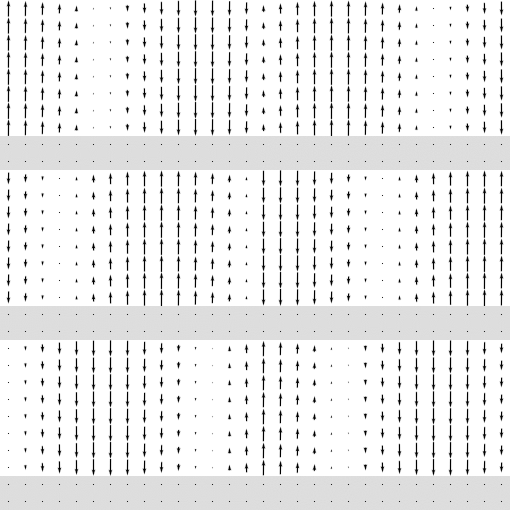
The Eastward-field of a surface plasmon polariton at a silvery–air interface, at a frequency corresponding to a costless-space wavelength of 10μm. At this frequency, the silver behaves approximately as a perfect electric usher, and the SPP is called a Sommerfeld–Zenneck wave, with well-nigh the same wavelength as the costless-infinite wavelength.
The surface plasmon polariton (SPP) is an electromagnetic surface wave that can travel along an interface between two media with dissimilar dielectric constants. It exists under the condition that the permittivity of one of the materials [6] forming the interface is negative, while the other one is positive, as is the case for the interface betwixt air and a lossy conducting medium below the plasma frequency. The wave propagates parallel to the interface and decays exponentially vertical to it, a property called evanescence. Since the wave is on the purlieus of a lossy usher and a second medium, these oscillations can exist sensitive to changes to the boundary, such as the adsorption of molecules by the conducting surface.[16]
Sommerfeld–Zenneck surface wave [edit]
The Sommerfeld–Zenneck wave or Zenneck moving ridge is a not-radiative guided electromagnetic moving ridge that is supported by a planar or spherical interface betwixt ii homogeneous media having different dielectric constants. This surface moving ridge propagates parallel to the interface and decays exponentially vertical to information technology, a property known as evanescence. It exists under the status that the permittivity of one of the materials forming the interface is negative, while the other one is positive, equally for instance the interface between air and a lossy conducting medium such as the terrestrial transmission line, below the plasma frequency. Its electric field forcefulness falls off at a rate of e-αd/√d in the direction of propagation along the interface due to two-dimensional geometrical field spreading at a rate of 1/√d, in combination with a frequency-dependent exponential attenuation (α), which is the terrestrial manual line dissipation, where α depends on the medium's electrical conductivity. Arising from original analysis by Arnold Sommerfeld and Jonathan Zenneck of the problem of wave propagation over a lossy world, it exists as an exact solution to Maxwell'southward equations.[17] The Zenneck surface moving ridge, which is a not-radiating guided-moving ridge style, can be derived by employing the Hankel transform of a radial ground current associated with a realistic terrestrial Zenneck surface moving ridge source.[6] Sommerfeld-Zenneck surface waves predict that the free energy decays every bit R−1 because the free energy distributes over the circumference of a circle and not the surface of a sphere. Evidence does non show that in radio space wave propagation, Sommerfeld-Zenneck surfaces waves are a mode of propagation as the path-loss exponent is mostly betwixt 20 dB/dec and 40 dB/december.
See also [edit]
- Seismic waves
- Seismic advice
- P-waves
- South-waves
- Surface acoustic wave
- Sky waves, the master means of HF transmission
- Surface plasmon, a longitudinal accuse density wave along the interface of conducting and dielectric mediums
- Surface-wave-sustained mode, a propagation of electromagnetic surface waves.
- Evanescent waves and evanescent moving ridge coupling
- Ocean surface waves, internal waves and crests, dispersion, and freak waves
- Dear wave and Rayleigh–Lamb moving ridge
- Gravity waves, occurs at certain natural interfaces (e.k. the temper and ocean)
- Stoneley wave
- Scholte wave
- Dyakonov surface wave
- People
- Arnold Sommerfeld – published a mathematical treatise on the Zenneck wave
- Jonathan Zenneck – Pupil of Sommerfeld; Wireless pioneer; developed the Zenneck wave
- John Stone Stone – Wireless pioneer; produced theories on radio propagation
- Other
- Basis constants, the electrical parameters of earth
- Virtually and far field, the radiated field that is within one quarter of a wavelength of the diffracting edge or the antenna and beyond.
- Peel upshot, the trend of an alternating electric electric current to distribute itself within a usher and then that the current density near the surface of the conductor is greater than that at its cadre.
- Surface moving ridge inversion
- Green'due south function, a office used to solve inhomogeneous differential equations subject area to purlieus conditions.
References [edit]
- ^
 This article incorporates public domain material from Federal Standard 1037C. General Services Administration. (in back up of MIL-STD-188).
 - ^ The Physical Reality of Zenneck'south Surface Wave.
- ^ Hill, D. A., and J. R. Look (1978), Excitation of the Zenneck surface wave by a vertical aperture, Radio Sci., thirteen(6), 969–977, doi:10.1029/RS013i006p00969.
- ^ Goubau, Chiliad., "Über die Zennecksche Bodenwelle," (On the Zenneck Surface Wave), Zeitschrift für Angewandte Physik, Vol. three, 1951, Nrs. iii/four, pp. 103–107.
- ^ Barlow, H.; Brown, J. (1962). "II". Radio Surface Waves. London: Oxford University Press. pp. x–12.
- ^ a b c Corum, K. L., Yard. W. Miller, J. F. Corum, "Surface Waves and the Crucial Propagation Experiment," Proceedings of the 2016 Texas Symposium on Wireless and Microwave Circuits and Systems (WMCS 2016), Baylor Academy, Waco, TX, March 31-April 1, 2016, IEEE, MTT-S, ISBN 9781509027569.
- ^ Expect, James, "Excitation of Surface Waves on Conducting, Stratified, Dielectric-Clad, and Corrugated Surfaces," Journal of Inquiry of the National Agency of Standards Vol. 59, No.vi, December 1957.
- ^ Dyakonov, Yard. I. (April 1988). "New type of electromagnetic wave propagating at an interface". Soviet Physics JETP. 67 (iv): 714. Bibcode:1988JETP...67..714D.
- ^ Takayama, O.; Crasovan, 50. C., Johansen, S. K.; Mihalache, D, Artigas, D.; Torner, L. (2008). "Dyakonov Surface Waves: A Review". Electromagnetics. 28 (iii): 126–145. doi:x.1080/02726340801921403. S2CID 121726611.
- ^ Takayama, O.; Crasovan, L. C., Artigas, D.; Torner, 50. (2009). "Observation of Dyakonov surface waves". Physical Review Letters. 102 (4): 043903. Bibcode:2009PhRvL.102d3903T. doi:x.1103/PhysRevLett.102.043903. PMID 19257419.
- ^ Takayama, O.; Artigas, D., Torner, L. (2014). "Lossless directional guiding of calorie-free in dielectric nanosheets using Dyakonov surface waves". Nature Nanotechnology. 9 (half-dozen): 419–424. Bibcode:2014NatNa...9..419T. doi:10.1038/nnano.2014.ninety. PMID 24859812.
- ^ Takayama, O.; Bogdanov, A. A., Lavrinenko, A. V. (2017). "Photonic surface waves on metamaterial interfaces". Journal of Physics: Condensed Matter. 29 (46): 463001. Bibcode:2017JPCM...29T3001T. doi:ten.1088/1361-648X/aa8bdd. PMID 29053474.
- ^ Liu, Hsuan-Hao; Chang, Hung-Chun (2013). "Leaky Surface Plasmon Polariton Modes at an Interface Between Metal and Uniaxially Anisotropic Materials". IEEE Photonics Periodical. five (6): 4800806. Bibcode:2013IPhoJ...500806L. doi:10.1109/JPHOT.2013.2288298.
- ^ Collin, R. East., Field Theory of Guided Waves, Chapter 11 "Surface Waveguides". New York: Wiley-IEEE Press, 1990.
- ^ "(TM) mode" (PDF). corridor.biz. Archived (PDF) from the original on 2022-x-09. Retrieved 4 Apr 2018.
- ^ S. Zeng; Baillargeat, Dominique; Ho, Ho-Pui; Yong, Ken-Tye (2014). "Nanomaterials enhanced surface plasmon resonance for biological and chemic sensing applications". Chemic Society Reviews. 43 (x): 3426–3452. doi:10.1039/C3CS60479A. PMID 24549396.
- ^ Barlow, H.; Brown, J. (1962). Radio Surface Waves. London: Oxford University Printing. pp. 5, seven.
Further reading [edit]
Standards and doctrines [edit]
- "Surface wave". Telecom Glossary 2000, ATIS Committee T1A1, Performance and Betoken Processing, T1.523–2001.
- "Surface wave", Federal Standard 1037C.
- "Surface wave", MIL-STD-188
- "Multi-service tactics, techniques, and procedures for the High-Frequency Automatic Link Establishment (HF-ALE): FM half-dozen-02.74; MCRP three–40.3E; NTTP 6-02.6; AFTTP(I) 3-2.48; COMDTINST M2000.7" Sept., 2003.
Books [edit]
- Barlow, H.M., and Brownish, J., "Radio Surface Waves", Oxford Academy Press 1962.
- Budden, Grand. G., "Radio waves in the ionosphere; the mathematical theory of the reflection of radio waves from stratified ionised layers". Cambridge, Eng., Academy Press, 1961. LCCN 61016040 /L/r85
- Budden, K. G., "The wave-guide mode theory of moving ridge propagation". London, Logos Press; Englewood Cliffs, N.J., Prentice-Hall, c1961. LCCN 62002870 /L
- Budden, K. G., " The propagation of radio waves : the theory of radio waves of low power in the ionosphere and magnetosphere". Cambridge (Cambridgeshire); New York : Cambridge University Press, 1985. ISBN 0-521-25461-two LCCN 84028498
- Collin, R. E., "Field Theory of Guided Waves". New York: Wiley-IEEE Printing, 1990.
- Foti, S., Lai, C.G., Rix, G.J., and Strobbia, C., ""Surface Wave Methods for Most-Surface Site Characterization"", CRC Press, Boca Raton, Florida (United states of america), 487 pp., ISBN 9780415678766, 2014 <https://www.crcpress.com/product/isbn/9780415678766>
- Sommerfeld, A., "Partial Differential Equations in Physics" (English version), Academic Press Inc., New York 1949, chapter 6 – "Bug of Radio".
- Polo, Jr., J. A., Mackay, T. G., and Lakhtakia, A., "Electromagnetic Surface Waves: A Modern Perspective". Waltham, MA, The states: Elsevier, 2013 <https://www.elsevier.com/books/electromagnetic-surface-waves/polo/978-0-12-397024-iv>.
- Rawer, K.,"Wave Propagation in the Ionosphere", Dordrecht, Kluwer Acad.Publ. 1993.
- Sommerfeld, A., "Fractional Differential Equations in Physics" (English version), Academic Press Inc., New York 1949, chapter vi – "Problems of Radio".
- Weiner, Melvin M., "Monopole antennas" New York, Marcel Dekker, 2003. ISBN 0-8247-0496-7
- Wait, J. R., "Electromagnetic Wave Theory", New York, Harper and Row, 1985.
- Wait, J. R., "The Waves in Stratified Media". New York: Pergamon, 1962.
- Waldron, Richard Arthur, "Theory of guided electromagnetic waves". London, New York, Van Nostrand Reinhold, 1970. ISBN 0-442-09167-2 LCCN 69019848 //r86
- Weiner, Melvin K., "Monopole antennas" New York, Marcel Dekker, 2003. ISBN 0-8247-0496-7
Journals and papers [edit]
- Zenneck, Sommerfeld, Norton, and Goubau
- J. Zenneck, (translators: P. Blanchin, 1000. Guérard, É. Picot), "Précis de télégraphie sans fil : complément de 50'ouvrage : Les oscillations électromagnétiques et la télégraphie sans fil", Paris : Gauthier-Villars, 1911. 8, 385 p. : sick. ; 26 cm. (Tr. "Precisions of wireless telegraphy: complement of the work: Electromagnetic oscillations and wireless telegraphy.")
- J. Zenneck, "Über die Fortpflanzung ebener elektromagnetischer Wellen längs einer ebenen Leiterfläche und ihre Beziehung zur drahtlosen Telegraphie", Annalen der Physik, vol. 23, pp. 846–866, Sept. 1907. (Tr. "Most the propagation of electromagnetic plane waves along a usher airplane and their relationship to wireless telegraphy.")
- J. Zenneck, "Elektromagnetische Schwingungen und drahtlose Telegraphie", gart, F. Enke, 1905. xxvii, 1019 p. : ill. ; 24 cm. (Tr. "Electromagnetic oscillations and wireless telegraphy.")
- J. Zenneck, (translator: A.E. Seelig) "Wireless telegraphy,", New York [etc.] McGraw-Hill Book Company, inc., 1st ed. 1915. xx, 443 p. illus., diagrs. 24 cm. LCCN 15024534 (ed. "Bibliography and notes on theory" pp. 408–428.)
- A. Sommerfeld, "Über die Fortpflanzung elektrodynamischer Wellen längs eines Drahtes", Ann. der Physik und Chemie, vol. 67, pp. 233–290, December 1899. (Tr. "Propagation of electro-dynamic waves along a cylindric usher.")
- A. Sommerfeld, "Über die Ausbreitung der Wellen in der drahtlosen Telegraphie", Annalen der Physik, Vol. 28, pp. 665–736, March 1909. (Tr. "Nearly the Propagation of waves in wireless telegraphy.")
- A. Sommerfeld, "Propagation of waves in wireless telegraphy," Ann. Phys., vol. 81, pp. 1367–1153, 1926.
- K. A. Norton, "The propagation of radio waves over the surface of the earth and in the upper atmosphere," Proc. IRE, vol. 24, pp. 1367–1387, 1936.
- 1000. A. Norton, "The calculations of ground wave field intensity over a finitely conducting spherical world," Proc. IRE, vol. 29, pp. 623–639, 1941.
- G. Goubau, "Surface waves and their application to transmission lines," J. Appl. Phys., vol. 21, pp. 1119–1128; Nov,1950.
- G. Goubau, "Über dice Zennecksche Bodenwelle," (Tr."On the Zenneck Surface Wave."), Zeitschrift für Angewandte Physik, Vol. iii, 1951, Nrs. iii/4, pp. 103–107.
- Wait
- Wait, J. R., "Lateral Waves and the Pioneering Research of the Late Kenneth A Norton".
- Wait, J. R., and D. A. Hill, "Excitation of the HF surface wave by vertical and horizontal apertures". Radio Science, 14, 1979, pp 767–780.
- Wait, J. R., and D. A. Hill, "Excitation of the Zenneck Surface Wave by a Vertical Discontinuity", Radio Science, Vol. 13, No. 6, November–December, 1978, pp. 969–977.
- Wait, J. R., "A annotation on surface waves and ground waves", IEEE Transactions on Antennas and Propagation, November 1965. Vol. 13, Issue six, pp. 996–997 ISSN 0096-1973
- Expect, J. R., "The ancient and mod history of EM ground-moving ridge propagation". IEEE Antennas Propagat. Mag., vol. 40, pp. seven–24, October. 1998.
- Wait, J. R., "Appendix C: On the theory of ground wave propagation over a slightly roughned curved earth", Electromagnetic Probing in Geophysics. Boulder, CO., Golem, 1971, pp. 37–381.
- Wait, J. R., "Electromagnetic surface waves", Advances in Radio Research, 1, New York, Bookish Printing, 1964, pp. 157–219.
- Others
- R. E. Collin, "Hertzian Dipole Radiating Over a Lossy Earth or Sea: Some Early and Late 20th-Century Controversies", Antennas and Propagation Magazine, 46, 2004, pp. 64–79.
- F. J. Zucker, "Surface wave antennas and surface moving ridge excited arrays", Antenna Applied science Handbook, 2nd ed., R. C. Johnson and H. Jasik, Eds. New York: McGraw-Colina, 1984.
- Yu. V. Kistovich, "Possibility of Observing Zenneck Surface Waves in Radiation from a Source with a Pocket-size Vertical Aperture", Soviet Physics Technical Physics, Vol. 34, No.4, April, 1989, pp. 391–394.
- Five. I. Baĭbakov, 5. N. Datsko, Yu. V. Kistovich, "Experimental discovery of Zenneck's surface electromagnetic waves", Sov Phys Uspekhi, 1989, 32 (4), 378–379.
- Corum, K. L. and J. F. Corum, "The Zenneck Surface Wave", Nikola Tesla, Lightning Observations, and Stationary Waves, Appendix Two. 1994.
- M. J. Rex and J. C. Wiltse, "Surface-Moving ridge Propagation on Coated or Uncoated Metallic Wires at Millimeter Wavelengths". J. Appl. Phys., vol. 21, pp. 1119–1128; November,
- One thousand. J. King and J. C. Wiltse, "Surface-Wave Propagation on a Dielectric Rod of Electrical Cross-Section." Electronic Communications, Inc., Tirnonium: kld. Sci. Rept.'No. 1, AFCKL Contract No. AF xix(601)-5475; August, 1960.
- T. Kahan and One thousand. Eckart, "On the Electromagnetic Surface Moving ridge of Sommerfeld", Phys. Rev. 76, 406–410 (1949).
Other media [edit]
- L.A. Ostrovsky (ed.), "Laboratory modeling and theoretical studies of surface wave modulation by a moving sphere", one thousand, Oceanic and Atmospheric Research Laboratories, 2002. OCLC 50325097
External links [edit]
- The Feynman Lectures on Physics: Surface waves
- Eric W. Weisstein, et al., "Surface Wave", Eric Weisstein'due south World of Physics, 2006.
- David Reiss, "Electromagnetic surface waves". The Net Advance of Physics: Special Reports, No. 1
- Gary Peterson, "Rediscovering the Zenneck moving ridge". Feed Line No. four. (ed. reproduction available online at 21st Century Books)
- 3D Waves by Jesse Nochella based on a program by Stephen Wolfram, Wolfram Demonstrations Project.

Which Statement Describes Surface Waves,
Source: https://en.wikipedia.org/wiki/Surface_wave
Posted by: fourniervingligneedn.blogspot.com
0 Response to "Which Statement Describes Surface Waves"
Post a Comment